New Year Cards
Nengajou, Japan's New Year Postcards, Explained: Why the Shelf Fills Up All at Once Every Fall
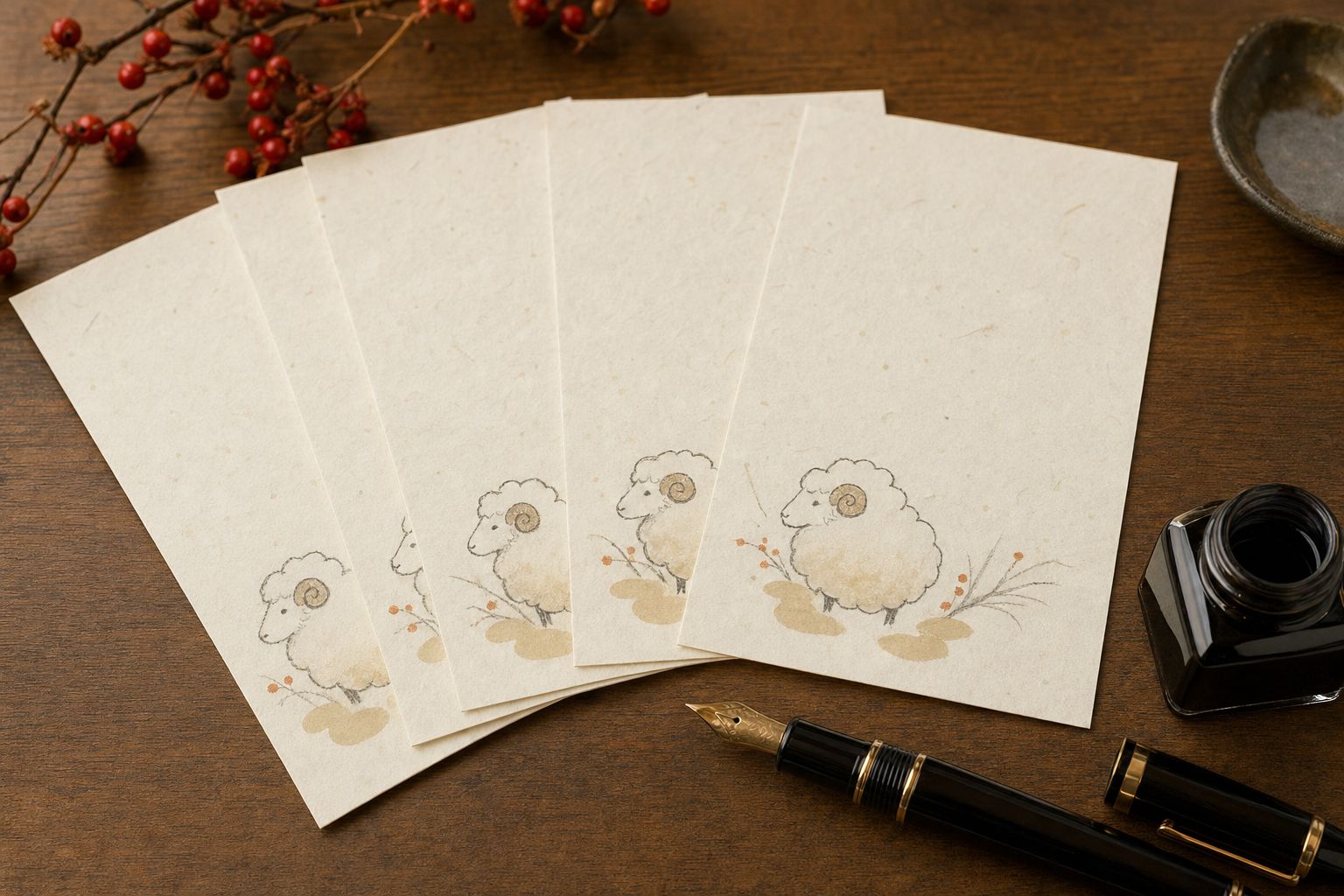
Every year, on one announced morning around the start of November, every post office in Japan starts selling a postcard built around one specific day two months later. Apart from a week of online orders beforehand, there’s no early-bird version. The shelf behind the counter is empty one day and full of them the next, and it stays that way until mid-January, at which point they disappear again until the following November.
The short answer: nengajou (年賀状) are Japan’s New Year’s postcards, sold as plain pre-stamped hagaki for ¥85 each, the same price as a regular postcard. This year’s batch for 2027 went on sale at 9 a.m. on November 2nd and will be sold through January 15th. If you want one to actually land on someone’s doorstep on January 1st, the mail has to go in by December 27th — miss that and Japan Post won’t promise New Year’s Day delivery at all.
It’s a postcard, but the clock is the product
A nengajou is, physically, just a postcard. What makes it different from any other ¥85 hagaki is the system wrapped around it: a window in which Japan Post treats mail differently on purpose.
Drop a nengajou in a postbox before December 20th and it won’t sit and wait — it goes out as ordinary mail and arrives within the normal day or two, defeating the entire point. The post office only starts holding New Year’s cards back and batching them for a single release starting December 20th. Everything collected from that date forward gets stockpiled rather than delivered immediately, then released all at once on January 1st, so that a stack of cards from coworkers, cousins, and that one aunt you only hear from in winter all show up on the same morning instead of trickling in across two weeks.
That batching only works if the volume arrives early enough to sort. Japan Post’s own guidance moved the “guaranteed by January 1st” cutoff to December 27th this cycle — two days later than the December 25th deadline from the year before. Miss it, and the card still gets delivered, just not necessarily on the day that makes it a nengajou rather than a late one.
One more quirk that trips up anyone used to a Western mail schedule: there’s no regular delivery on January 2nd. Mail runs again on January 1st and then on January 3rd, with a gap in between. It’s a small detail, but it’s the kind of thing you only learn by actually living through a Japanese New Year.
What’s actually printed on the thing
Every year’s nengajou carries that year’s zodiac animal somewhere on the design — this batch, for 2027, is a Year of the Sheep (未), so expect a lot of wool-colored illustrations on store shelves this winter. Plain, undesigned versions exist too, meant to be printed over at a convenience store kiosk or a home printer, which is what most people actually use if they’re sending more than a handful.
There’s also a lottery built in. Japan Post’s nengajou are otoshidama-tsuki (お年玉付き): each card prints a number in the corner, and Japan Post runs a drawing in January with prizes that run from cash down to a sheet of commemorative stamps. Hardly anyone treats this as a reason to send more cards. It’s closer to a receipt you don’t throw away until you’ve checked, once, whether you won anything.
Why a shrinking ritual still gets a release date
Here’s the part that doesn’t fit the image of a dying tradition: the initial print run has fallen for sixteen straight years — Japan Post announced about 556 million cards for 2027, down 25.7% from the year before and less than a fifth of the 2004 peak — and Japan Post is still printing hundreds of millions of them and still treating the launch like an event with a fixed date and a fixed price.
I think that’s the actual story, more than the decline itself. LINE messages and group chats have taken over a lot of the casual New Year greetings between friends, and there’s no point pretending otherwise. But the postcard is still common in more formal relationships: a card to a boss, a client, a teacher, or older relatives is still a normal thing to send, and a LINE sticker doesn’t read the same way a stamped, handwritten card does in that specific relationship. The ritual survived by narrowing, not by dying.
That’s also roughly where the price sits now. A plain hagaki went from ¥63 to ¥85 in Japan Post’s October 2024 rate change, and nengajou moved with it. It’s not expensive card by card. It adds up fast once you’re writing fifteen or twenty by hand in one sitting in December, which is exactly when everyone else in the country is doing the same thing.
How to actually send one without getting the dates wrong
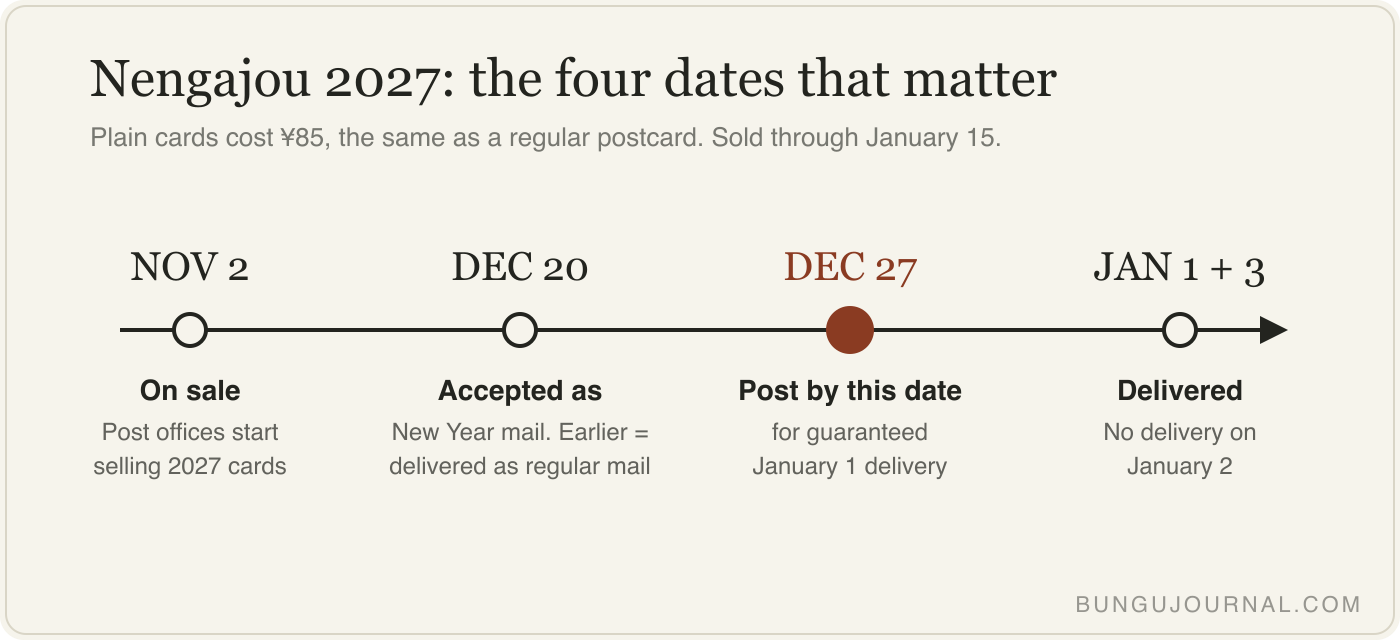
- Buy on or after the release date. For 2027 cards that was November 2nd; the exact day shifts slightly from year to year (it was October 30th the year before), and post office shelves aren’t stocked until then.
- Don’t mail it before December 20th. Anything dropped in a postbox earlier ships as regular mail and shows up early, which isn’t what a nengajou is for.
- Mail it by December 27th. That’s this cycle’s cutoff for a guaranteed January 1st arrival. After that, Japan Post still delivers it — just not necessarily on New Year’s Day.
- Address it the Japanese way if you’re sending to a Japanese household: surname first, and a respectful suffix like -sama rather than -san for anyone you’re not personally close to. Getting this wrong on a card to your boss is the kind of small mistake that gets noticed.
- Write the greeting by hand if you can. A printed card isn’t rude, but a line or two in actual handwriting is the whole reason the format survived group chats. If you’re building toward a hand you’re proud of, my rundown of why Japanese pens write the way they do and a beginner’s case for a first fountain pen are both relevant here — a good nib makes four lines of New Year’s greeting feel less like a chore.
Where to actually get a stack
You don’t need a post office visit just to buy the blank cards. Convenience stores carry small packs around the release window, and stationery floors at Loft or Hands stock both the plain lottery version and fully illustrated ones ready to write on — my guide to where stationery actually gets bought in Tokyo covers which of those stores is worth the trip versus which one is just convenient. If you already treat December as the month your planner shelf fills up too, it’s worth reading alongside why Japan’s techo season runs on its own calendar — both rituals hit the same few weeks of the year for the same reason: everyone in the country is working off the same printed deadline.
The yearly count will probably keep shrinking. But if you do send one, the December 27th cutoff strikes me as a deadline not worth testing — showing up two days late to something this specific feels worse than not sending anything at all.
— Sen
The Desk Reset (Free)
A 10-minute checklist to set up a calm, analog-friendly desk — built on 5S, Japan's tidy-workplace method. Printable, one page.
Get the checklist →