Pen Culture
Why Japanese Pens Write Better: 3 Surprises from Japan
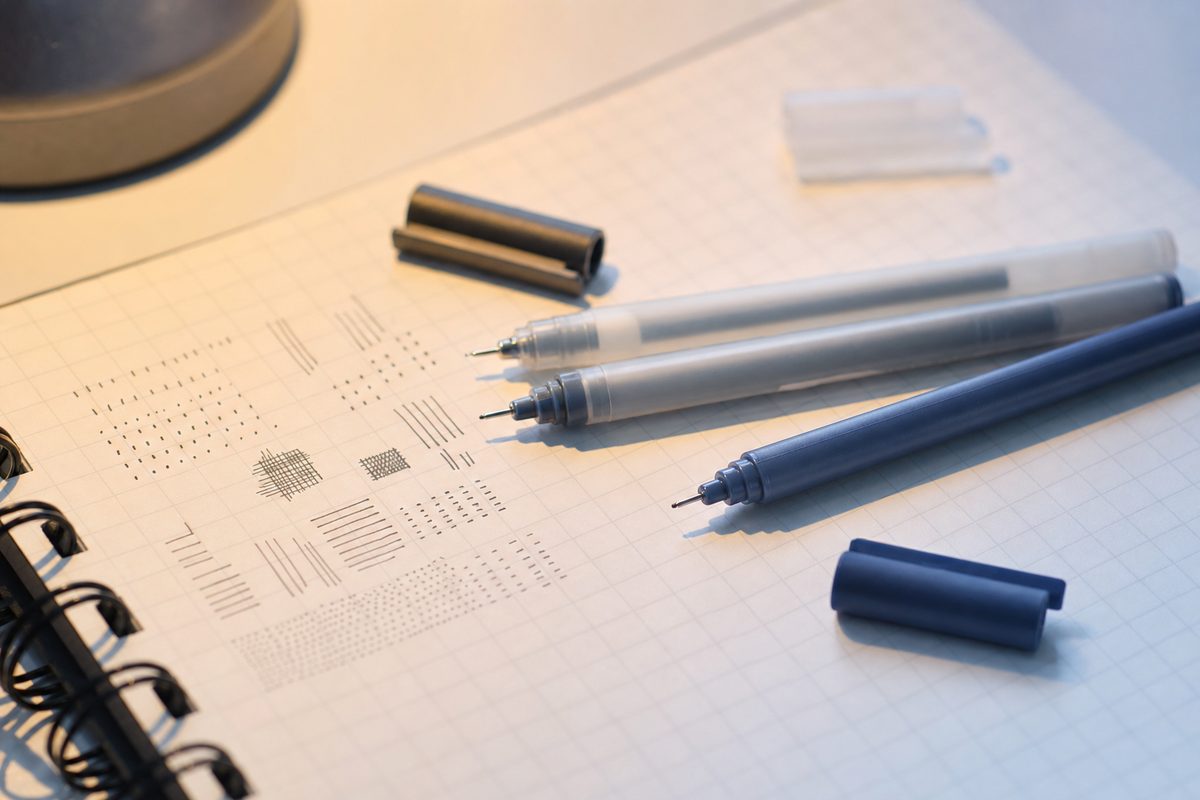
Ask any stationery obsessive to name their favorite everyday pens and the list often sounds like a Tokyo train announcement: Uni-ball, Pilot, Zebra, Pentel. There are three reasons behind that, and each surprises people who didn’t grow up here: the writing system pushed tips finer, gel ink was invented in Japan, and ordinary cheap pens get serious engineering attention. Once you know them, the whole best-pens landscape makes sense.
Reason one: the language demanded finer tips
Here’s the origin story in one image: try writing 憂鬱 — “melancholy,” 44 strokes across two characters (the second one alone is 29) — with a chunky 1.0mm ballpoint in a space five millimeters square. You get a black smudge.
Japanese (and Chinese) writing packs dramatically more strokes into the same cell than the Latin alphabet does. Students fill exam grids, planners have famously tiny boxes, and every stroke has to stay distinct. I filled those answer grids all through school here, like everyone else. Western pen makers had no reason to build a reliable 0.38mm tip; nobody writing “the” needed one. Japanese makers had an entire population that did.
You can see the result in the makers’ own lineups. Mitsubishi Pencil sells the uni-ball Signo gel pen in 0.28, 0.38 and 0.5mm; Pilot’s Juice up comes in 0.3, 0.4 and 0.5mm. A 0.28mm ball is barely more than a quarter of a millimeter across, and making one that writes smoothly without skipping is a precision-manufacturing problem. Japanese makers had a home market that wanted those tips, and built the capability to supply them.
Reason two: the gel ink revolution happened in Japan
The other half of the story is chemistry. Oil-based ballpoint ink (the Bic default) is reliable but gluey — it needs pressure, and it writes gray-ish. Water-based rollerballs glide but bleed and smear.
Gel ink — pigment suspended in a water-based gel that liquefies under the ball and sets instantly on paper — split the difference: vivid, dark, low-pressure, fast-drying. Sakura Color Products, the Osaka company behind Cray-Pas, says in its official history that in 1984 it developed the world’s first water-based gel ink ballpoint, the Ballsign. Japanese makers have kept refining gel ink since, and today’s versions differ in drying speed, color and line consistency — which is why left-handed writers, for example, often get pointed to specific quick-drying gel models.
The practical consequence: an inexpensive Japanese gel pen can give you a fine, dark, consistent line at a price where that’s surprising. Whether it suits you better than any other pen depends on your hand, your paper and what you write — it’s worth testing, not assuming.
Reason three: the culture takes ¥150 objects seriously
The deeper reason — the one that explains why the iteration never stops — is that Japan treats everyday tools as worthy of obsession. Stationery here is a mainstream adult interest: department stores dedicate floors to it, magazines rank pens annually, and a new ink formulation gets covered like a phone launch. There’s a word for this whole territory — bungu (文具) — and no perfect English translation, which is roughly why this site exists.
When a market cares that much, a maker can justify re-engineering a pen clip or reformulating an ink for a small improvement. Multiply that by several competing companies over decades, and you get shelves where even the cheap pens are carefully engineered. It’s the same cultural machinery that produces planners people organize their lives around.
So which tip size is “right”?
The honest starter map:
- 0.5mm — the safe default for most English handwriting. Fine but forgiving.
- 0.38mm — the sweet spot once your hand adjusts. Precise without scratching. This is the rabbit hole’s front door.
- 0.28mm and below — for tiny planners, margin notes, and people whose handwriting resembles microfilm. Wonderful, specialized.
- 0.7mm+ — signatures and whiteboard-adjacent boldness. Fine, but you’re leaving the magic on the table.
If you’re coming from Western pens, the first week at 0.38mm feels needle-like. Then your notes get smaller, neater, and oddly satisfying, and 1.0mm pens start feeling like writing with a crayon. I’m sorry in advance: this is a one-way door.
Japanese pens write better because an entire country quietly refused to accept that a cheap pen should write badly. The least you can do is borrow the result.
For specific pens by job — gel, ballpoint, fine-tip — see Japanese pens, sorted, and for the paper to put them on, the Japanese notebook guide.
— Sen
The Desk Reset (Free)
A 10-minute checklist to set up a calm, analog-friendly desk — built on 5S, Japan's tidy-workplace method. Printable, one page.
Get the checklist →