Planners
Japan's Techo Season: Why Planner Shelves Explode Every Autumn (and How to Pick One)

Right now, if you walked into a Loft or a station bookstore anywhere in Japan, you’d find a whole section that doesn’t exist back home: a wall of next year’s planners, months before the year it covers has even started. This isn’t a one-off release. It’s a season, and it runs from late summer through December.
The short answer: Japan’s planner (“techo,” 手帳) season hits full speed around early September. Hobonichi has released on September 1st in recent years, Loft’s displays reached full scale that same week in 2026, and the section keeps its place through November and December. If you’re buying your first one, don’t start with the famous blank-page Hobonichi. Start with a cheap Takahashi techo under ¥1,500, figure out whether you actually want a January-start or an April-start calendar, and upgrade next year once you know your own habits.
Why this is a season and not just a product launch
Here’s the part that’s easy to miss if you’re shopping from outside Japan: the shelf doesn’t fill up because one company has a big release. It fills up because a whole category is selling next year’s book at the same time, the way U.S. retail piles into Black Friday.
Hobonichi’s 2027 planners went on sale September 1st, 2026, at 11 a.m. (not “sometime in September,” an actual clock time, though it varied by store), through the Hobonichi store, its TOBICHI shops, Loft, Amazon, and Rakuten. I’ve written separately about what the Hobonichi Techo actually is and who it’s wrong for.
Takahashi Shoten, another big planner publisher, plays a different game. It floods the shelf with options. Its 2025 lineup alone ran to 193 different April-start planners: sizes, layouts, cover materials, aimed at everyone from teenagers to office veterans. That’s a company competing on breadth instead of hype.
The calendar-start problem nobody warns you about
This is the one mistake that actually ruins a planner, and it has nothing to do with paper quality.
Japan runs on two overlapping calendars. The civil year starts January 1st, same as anywhere. But the school year and many corporate fiscal years start in April. Stationery publishers serve both, which is why the same planner line (Takahashi’s New Diary, for instance) comes in a January-start version and a separate April-start version.
Here’s the catch for autumn shoppers: the April-start books come later. Takahashi’s 193-item April lineup for 2025 went on sale that February. So if your life runs on an April year, the autumn wall may not be your wall yet.
Buy the wrong one and you don’t get a ruined planner exactly. You get a year that breaks in the wrong place: the book runs out in the middle of your school or fiscal year, and you’re moving your plans into a new one at the worst moment. Check the first spread before you check anything else. The cover may not make it obvious.
What’s actually on the shelf, brand by brand
Three names you’ll run into in most store sections, and they’re not really competing for the same shopper.
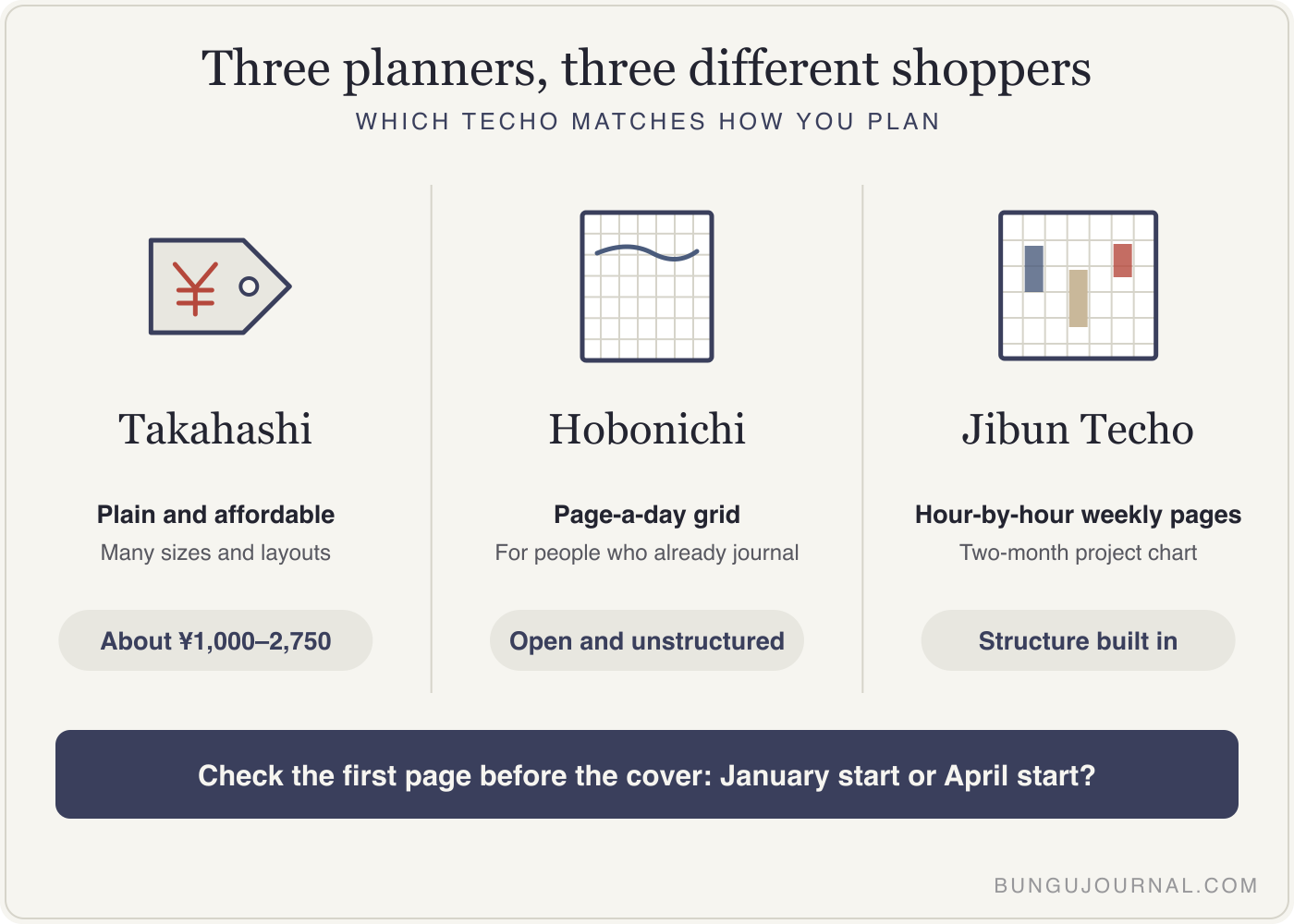
Takahashi is the budget-to-midrange workhorse. Retail prices run from about ¥1,000 for a compact pocket diary up to around ¥2,750 for a larger New Diary, which is why it’s so easy to recommend as a first book. It’s not trying to be a lifestyle object. It’s trying to be the planner you don’t think about.
Hobonichi is the one tourists have heard of, built around a page-a-day grid on famously thin Tomoe River paper. I go deeper on it in the Hobonichi breakdown, but the short version for techo-shopping season: it rewards people who already journal daily, and punishes everyone else with a half-filled, guilt-inducing object by February.
Kokuyo’s Jibun Techo sits in a third lane entirely, and it’s the one I’d point to if the Hobonichi’s total freedom sounds stressful rather than liberating. Instead of a blank grid, it gives you a vertical, hour-by-hour weekly timeline and a two-month project schedule that works like a Gantt chart. The 2026 lineup lists for roughly ¥3,000 to ¥5,000 depending on edition (Lite mini, Diary, Biz, DAYs, or the three-volume First Kit), tax included. If a planner with no structure makes you anxious, this one hands you the structure up front.
There’s also a trivia detail that tells you something real about how seriously this category is taken here. Takahashi Shoten runs an annual contest called the Techo Taisho (2026 was its 30th edition), with two prizes: one for a memorable remark, one for an idea for a new planner product. A planner company asking the public for lines worth keeping, for 30 rounds now, is a very Japanese kind of seriousness about a very ordinary object.
Honestly, my own setup is a ballpoint and plain paper
I should be straight with you here: I don’t use much stationery these days. It’s a ballpoint and plain paper for whatever I need to jot down. So take the brand opinions above as research, not a daily-user review.
The season itself is hard to miss, though. Loft’s 2026 displays started rolling out in early August and hit full scale from September 5th. By autumn the section is just there, the way the oden pot shows up at the convenience store register around the same time of year.
Mistakes that actually cost you a year
- Buying size before testing habit. The A5 “Cousin” size feels generous in the store and oppressive by week three if you don’t actually write that much. If you’re not sure, a B6 slim or A6 is the safer first purchase. You can always go bigger next year.
- Starting in January when your life runs in April. Covered above, but it’s worth repeating: check the first page, not the cover.
- Buying the famous one because it’s famous. The Hobonichi’s open grid is a genuinely different product from the Jibun Techo’s structured timeline, and from Takahashi’s plain weekly layout. “Which one is the best techo” is the wrong question. “Which one matches how I actually plan my week” is the right one.
- Committing a full year’s budget before testing the paper. If you already know you write with a fountain pen, check how the paper performs before buying a year of it. The same logic I cover in my notebook paper comparison applies here too.
If you want to see the shelf in person
The techo displays are worth seeing even if you end up ordering online. Flipping through a dozen layouts side by side tells you more in five minutes than any review does. I’ve laid out what each big store is good for in my guide to Tokyo’s stationery stores, and Loft is the easy place to start during this season.
Buy small the first year. A ¥1,000 Takahashi won’t change your life, and that’s the point. It’ll teach you what you actually want before you spend real money finding out the hard way.
The Desk Reset (Free)
A 10-minute checklist to set up a calm, analog-friendly desk — built on 5S, Japan's tidy-workplace method. Printable, one page.
Get the checklist →