Washi Tape
mt Washi Tape, Explained: Why Japan Still Just Calls It Masking Tape
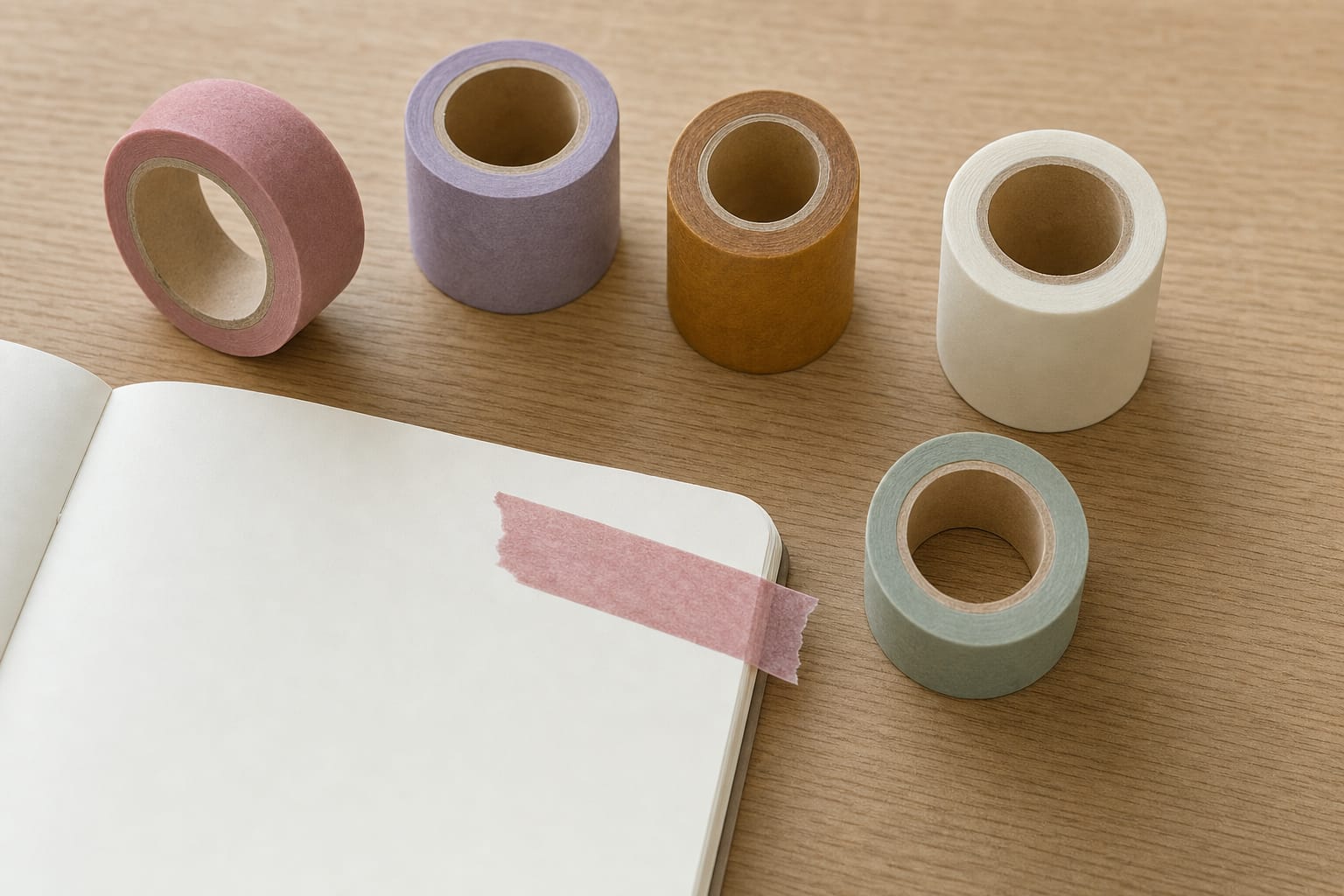
Ask someone in Tokyo where to buy washi tape and you’ll usually get a blank look — not because it’s hard to find, but because almost nobody here calls it that. Walk into any stationery floor and the shelf label just says マスキングテープ: masking tape, the same two words a contractor uses for the blue roll that protects a wall before painting. The pretty striped and polka-dotted tape sold abroad as a design object is, on its home shelf, still filed next to the hardware.
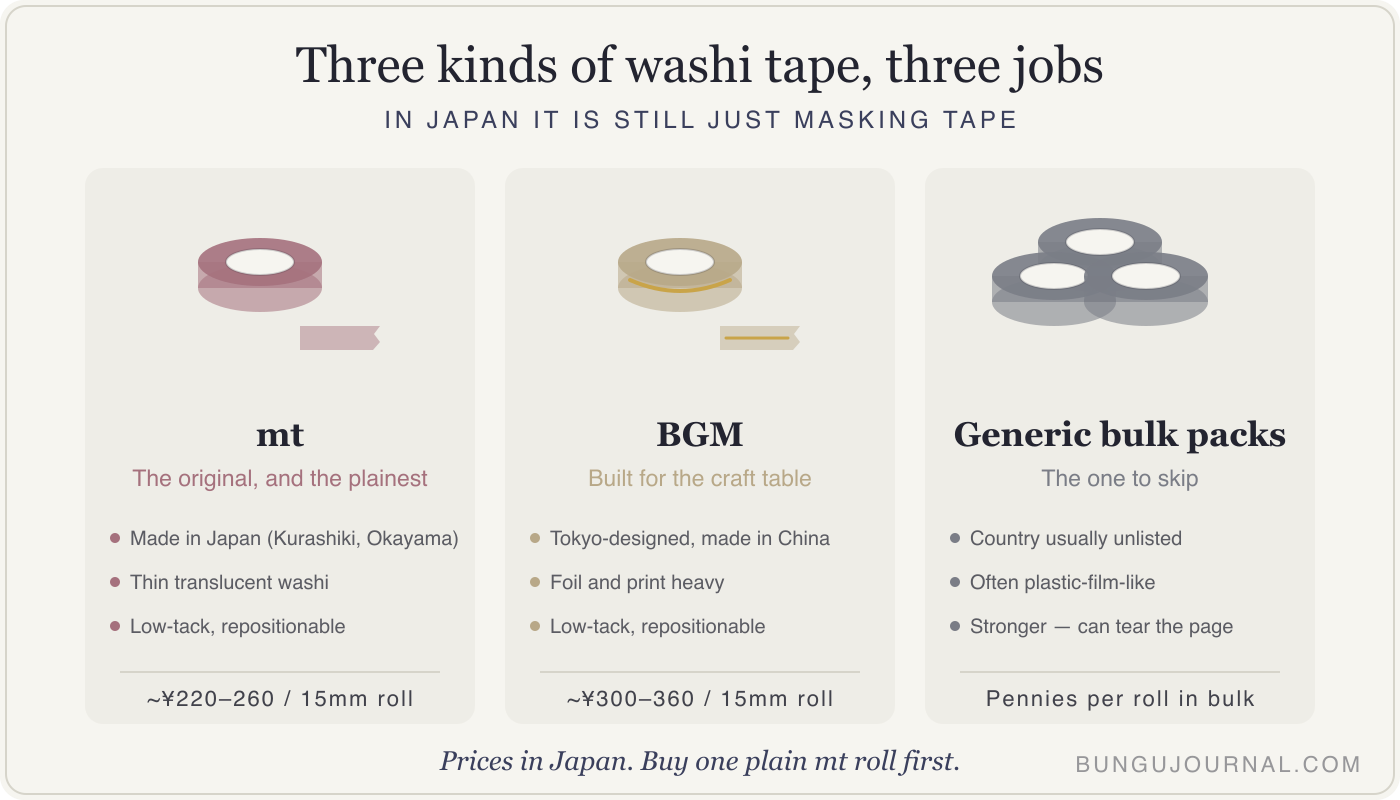
The short answer: if you want the tape that started this whole category, buy mt (roughly ¥220–260 for a standard 15mm roll) — it’s made by the company that’s been based in Kurashiki, Okayama since 1923, and the paper is thin enough to tear by hand and layer without looking bulky. If you want tape built for scrapbooking rather than repainting a wall — foil accents, character art, gift-wrap patterns — get BGM instead; a 15mm roll runs closer to ¥300–360, and unlike mt it’s manufactured in China rather than at a Japanese mill, though the designs are built for a different job entirely. Skip the 40-roll “washi tape variety pack” sold in bulk online; more on why below.
The industrial tape a scrapbook turned into a hobby
Kamoi Kakoshi has existed in Kurashiki since 1923. For most of the company’s history since then, its tape did exactly what masking tape is supposed to do: protect a surface from paint, then peel off clean without residue. Nobody expected it to be beautiful.
That changed in 2006, when three women brought the company a handmade book. It was full of collage and artwork made from nothing but Kamoi’s own plain industrial tape — layered and cut into shapes, no glue or scissors involved beyond what the tape itself allowed. The staff hadn’t thought of their product that way. In 2008 they launched a separate consumer line under the name mt, short for masking tape — same adhesive, same washi paper base, just recolored and repackaged for a shelf instead of a construction site.
There’s a technical reason the tape looks the way it does, and it isn’t really about the printed color. Washi paper is thin enough to be slightly translucent, so when you layer two strips or lay one over handwriting, what’s underneath still shows through — a kind of built-in yohaku (余白), the deliberate blank space Japanese design tends to leave for something else to breathe through. A vinyl tape with the same pattern would just sit on top, opaque.
That translucency is also why it tears in a straight line by hand instead of needing scissors.
I’ve made the mistake of assuming “imported and pricier” automatically means “better” before, and not with tape — with a notebook. A colleague once talked me into an imported “premium” one instead of my usual Kokuyo, and it’s been sitting four pages deep in a drawer for over a year. Washi tape has the same trap built into it: plenty of what gets sold abroad as “authentic Japanese washi tape” is neither made in Japan nor particularly good paper, and the label rarely says so.
Three rolls, three different jobs
mt — the original, and still the plainest
At roughly ¥220–260 per 15mm roll (wider 20mm and 25mm widths exist too, and multi-roll gift boxes cost more per roll), mt is priced like the industrial product it descended from. The paper is matte, the adhesive is deliberately low-tack — built to be repositioned and removed, not to hold something down for years — and the color and pattern range runs into the hundreds, from plain solids to collaborations with textile designers. The catch: because the tack is so light, don’t use it anywhere it needs to actually hold weight, like taping a poster to a wall for months. It’ll let go eventually.
BGM — designed in Tokyo, made for the craft table
BGM is a Tokyo-headquartered stationery company, and its tape is aimed squarely at scrapbookers and planner decorators rather than anyone painting a room — foil-pressed gold lines, character illustrations, holiday sets. A standard 15mm roll runs closer to ¥300–360, noticeably more than mt for the same width, and BGM’s tape is manufactured in China rather than at a Japanese mill. That’s not a knock on quality; foil printing needs finer registration than mt’s plain dye process, and the extra cost is mostly buying that production work. It’s the one I reach for on a gift box, not a notebook.
Generic import multipacks — the one to skip
The 40- or 60-roll “washi tape set” bundles common on marketplace bulk listings are the thing to be careful of. Most aren’t made in Japan at all, the paper often feels closer to plastic film than actual washi, and the adhesive tends to run stronger and gummier than either mt or BGM — which sounds like an upgrade until you peel it off a page and take the top layer of paper with it. Buy one roll from an actual brand and try it before committing to a bulk set.
The comparison table
| mt | BGM | Generic import multipacks | |
|---|---|---|---|
| Made in | Japan (Kurashiki, Okayama) | China (Tokyo-designed) | Usually unlisted |
| Price (15mm roll) | ~¥220–260 | ~¥300–360 | Pennies per roll in bulk |
| Paper | Thin washi, translucent | Washi-based, foil/print heavy | Often plastic-film-like |
| Adhesive | Low-tack, repositionable | Low-tack, repositionable | Often stronger, can tear paper |
| Best for | Everyday journaling, layering | Scrapbooking, gift wrap, foil accents | — |
What I wouldn’t bother with
Don’t make the wide 25mm rolls your first purchase — they’re harder to tear straight by hand, and most projects call for the narrower widths anyway. And don’t expect washi tape to replace real repositionable adhesive for anything that needs actual hold, like mounting something you plan to move around a lot. The low tack that makes it removable is the same property that makes it a bad choice for anything heavier than paper.
One more thing worth saying plainly: none of this tape is waterproof. Leave a taped page somewhere humid — and a Tokyo summer does that on its own — and the adhesive can lift before you ever touch it.
Buying it from outside Japan
Inside Japan, both mt and BGM are easy to find at Loft, Hands (formerly Tokyu Hands), and most stationery counters for close to the yen prices above. Outside Japan, mt in particular ships internationally through its own store and larger craft retailers, though individual rolls usually cost more once shipping is added — a themed multi-roll set from the brand itself tends to work out cheaper per roll than ordering singles.
If you’re building a notebook system this tape would actually go into, my Kokuyo Campus vs. Midori MD comparison covers which paper handles decoration without warping, and the full Japanese notebook breakdown has more options if you’re starting from nothing. If color-coding interests you more than tape, the restraint behind mt’s muted palette runs through the same instinct as the Zebra Mildliner breakdown. And if you’re setting this up inside an actual planning system rather than loose pages, the Hobonichi Techo breakdown is where washi tape earns its keep.
Buy one mt roll in a plain color before the patterned sets. You’ll go through a plain roll faster than you’d expect, and the patterned ones tend to sit in a drawer longer than they should.
— Sen
The Desk Reset (Free)
A 10-minute checklist to set up a calm, analog-friendly desk — the Japanese office worker way. Printable, one page.
Get the checklist →