Sticky Notes
Japanese Sticky Notes, Explained: Fusen Brands and the Rule About Who Gets One
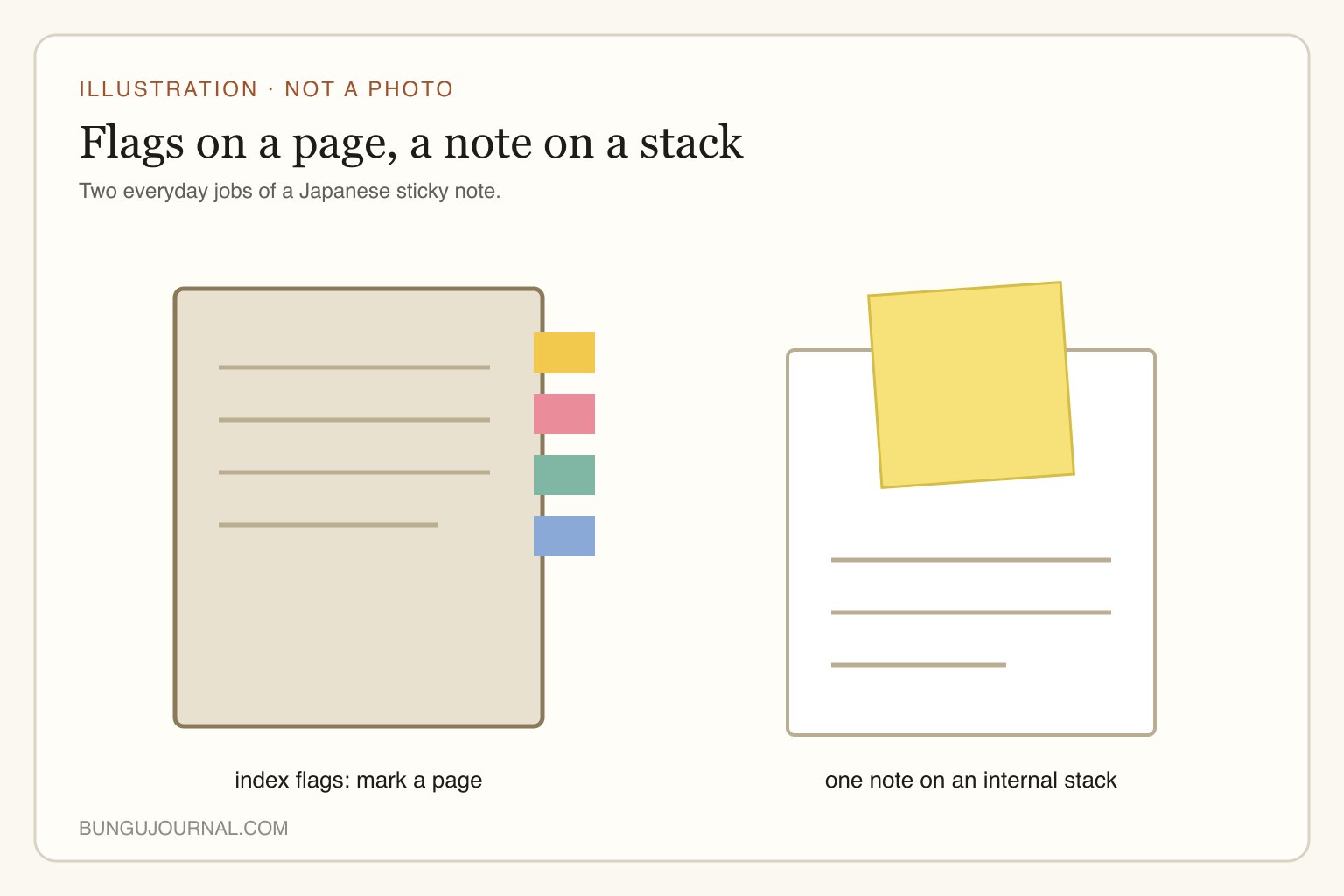
Open a drawer in almost any Japanese desk — office, classroom, kitchen counter — and there’s a little tower of sticky note pads in it. Nobody thinks twice about it. The surprising part, if you grew up assuming “fusen” (付箋, the Japanese word for them) was some old local invention Western offices later copied, is that the order runs the other way.
The short answer: the sticky note itself is an American invention from the 1970s, and 3M’s own Post-it brand is sold in Japan today same as anywhere else. What Japan actually built on top of the format is the interesting part: Kokuyo makes the no-nonsense office and study ones, Kanmido’s Coco Fusen line does the die-cut novelty shapes people collect, and there’s an unwritten office rule about which documents are allowed to get a sticky note stuck on them at all — more on that below. For a first pack, a plain Kokuyo set covers daily use; save the die-cut Kanmido shapes for a planner or a gift.
The sticky note was invented in Minnesota, not Tokyo
Spencer Silver, a chemist at 3M, was trying to invent a stronger adhesive in 1968 and ended up with the opposite: a glue that held paper in place but let go cleanly, with no residue. For years nobody at the company could think of a use for an adhesive that was supposed to fail at its one job. The idea that saved it came from a colleague, Art Fry, who was frustrated that his paper bookmarks kept sliding out of his hymnal during choir practice. 3M tested the result under the name Post ‘n Peel in a few American cities in the late 1970s before the national launch in 1980, under the name everyone actually remembers.
That’s the whole format, more or less unchanged since. Japan didn’t invent an alternative to it — 3M Japan (the company once known as Sumitomo 3M) sells the real Post-it brand here, stocked at ordinary office suppliers like Askul next to everything else. If you’ve pictured fusen as some parallel, uniquely Japanese product line that has nothing to do with Post-it, that’s not quite right. The yellow square on a Japanese desk can be the actual American one.
What’s genuinely different is what grew up around it once it landed.
The rule nobody mentions: who’s allowed to get one
Japanese business-manners guidance is specific on this point in a way that would never occur to most people outside Japan: a fusen note is for internal use. Stick one on a colleague’s draft to flag a typo, sure. Stick one on a document heading out to a client, and it reads as careless rather than casual — the expected move there is a proper cover note instead.
A fusen on a client’s contract is a small mistake with a big tell.
It’s a tiny rule, and it tells you something real about the format: in Japan, a sticky note isn’t neutral stationery. It’s read as shorthand for “quick, informal, between us” — which is exactly why it works so well for the use case it was actually built for, and exactly why it’s the wrong tool the moment the document leaves the building.
The brands actually worth knowing
Kokuyo — the plain one everyone already owns
Kokuyo is Japan’s largest stationery maker, and its sticky notes are the unglamorous default: plain colors, standard sizes, the kind that show up in every drawer without anyone remembering buying them. One example from Kokuyo’s own current lineup, the ME-1000-P notebook-style pad, lists at around ¥540 before tax — and Kokuyo’s own listing already flags it as being sold through while stock lasts, which is a very normal thing to happen to a specific SKU in a stationery market this crowded. The lesson isn’t “buy that exact one.” It’s that any single Kokuyo item you fall in love with might not be there next year, so write down the series name along with the product code.
Kanmido — the one people actually collect
Kanmido’s Coco Fusen line is the die-cut, shaped kind: animals, flowers, ribbons, little cards instead of plain squares. These are the ones that show up in planner-decorating communities and get bought as much for the shape as the function. International retailers like JetPens carry the line and price individual packs somewhere in the $4–6 range, depending on size and whether it’s a limited edition — worth knowing before you order a few packs rather than just one, since the limited runs disappear.
Post-it (3M Japan) — the baseline nobody treats as special
Worth saying plainly: the actual Post-it brand sits on the same shelves as Kokuyo and Kanmido in Japan, sold by 3M Japan, and nobody here treats it as an import novelty. It’s just one more option, usually the cheapest reliable one, and the honest starting point if you don’t care about shape or branding and just want something that sticks and peels.
What they’re actually used for
Three jobs come up more than any others, and none of them need a die-cut shape to work.
Marking a reference book without damaging it. Thin index-style flags stuck along the edge of a textbook or manual let you flip straight back to a page without dog-earing it or writing in the margin — the point isn’t decoration, it’s that the book stays sellable or reusable afterward.
Routing paper inside an office. A one-line note clipped to the top of a stack — “please check this,” “signature needed here” — is the internal use the business-manners rule above is actually protecting. It’s fast, it’s informal, and it’s meant to stay inside the building.
Flagging a spot in a stack of notes while studying. Narrow strip-shaped flags get used to bookmark a problem to come back to, rather than to write anything substantial on.
Fair warning: this is a category for people who still take notes on paper. If you mostly type, a small pack of index flags for the odd printed manual is plenty.
Comparing the three
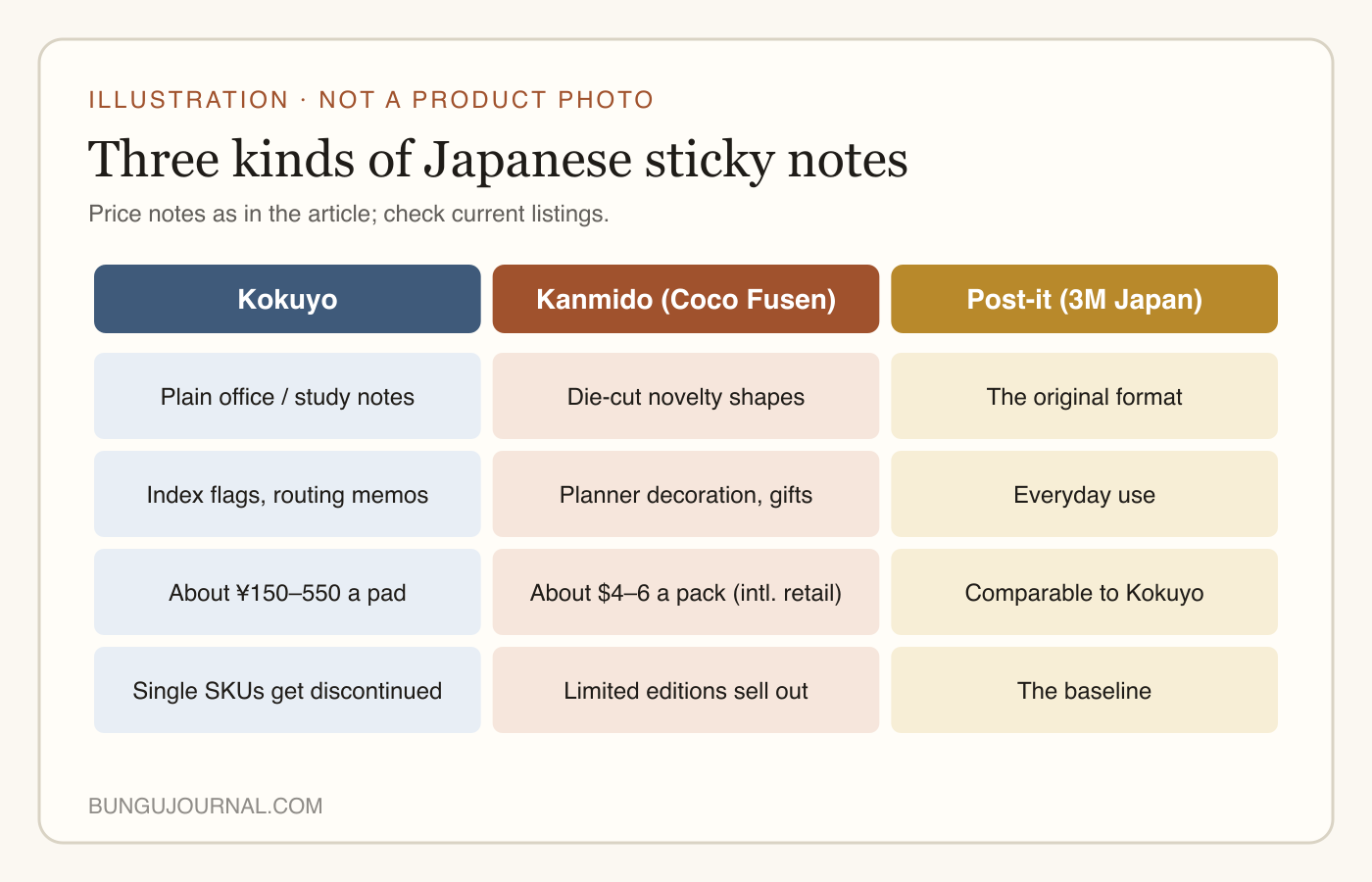
| Kokuyo | Kanmido (Coco Fusen) | Post-it (3M Japan) | |
|---|---|---|---|
| Known for | Plain, functional office/study notes | Die-cut novelty shapes | The original format, sold locally |
| Typical use | Index flags, routing memos | Planner decoration, gifting | General everyday use |
| Price range | Roughly ¥150–550 per pad | ~$4–6 per pack (international retail) | Comparable to Kokuyo |
| Watch out for | Specific SKUs get discontinued fast | Limited editions sell out | None — it’s the baseline |
What not to buy
Skip the unbranded 200-sheet bulk bricks sold as a single multipack online. The adhesive on cheap bulk fusen tends to run stronger than it needs to, which sounds like an upgrade until you peel one off a thin page and take a layer of paper with it — the same failure mode as cheap bulk washi tape, for the same reason: nobody optimized the glue for removability, just for “it definitely won’t fall off.”
The one to buy first
A plain Kokuyo set in two or three sizes covers index-flagging and office routing, which is most of what the format is actually for. Add a pack of Kanmido’s Coco Fusen only once you know you want something decorative for a planner or a gift — treat them as an occasional extra.
Quick recap:
- The format is American (3M, 1980); Japan built the culture around it, not the glue.
- Keep fusen internal — a client-facing document gets a proper cover note instead.
- Buy Kokuyo plain for function, Kanmido Coco Fusen for fun, and don’t assume one SKU will be in stock next year.
If you’re setting these up inside an actual notebook system rather than loose pages, the Kokuyo Campus vs. Midori MD comparison and the full Japanese notebook breakdown cover the paper they’ll end up stuck to. For color-coding the same study pages, the Zebra Mildliner breakdown pairs well with a set of index flags. And if you’re building a whole planning system around all of this, the Hobonichi Techo breakdown is where fusen actually earns a permanent spot.
That’s my bungu way.
— Sen
The Desk Reset (Free)
A 10-minute checklist to set up a calm, analog-friendly desk — built on 5S, Japan's tidy-workplace method. Printable, one page.
Get the checklist →